WATERVILL has now entered the implementation phase of activities under WP1, which focuses on analysing existing water supply systems and preparing the ground for pilot installation and implementation.
To this end, partners are currently assessing the state of existing water supply systems, which are often ageing and therefore, prone to leakages leading to significant water losses.
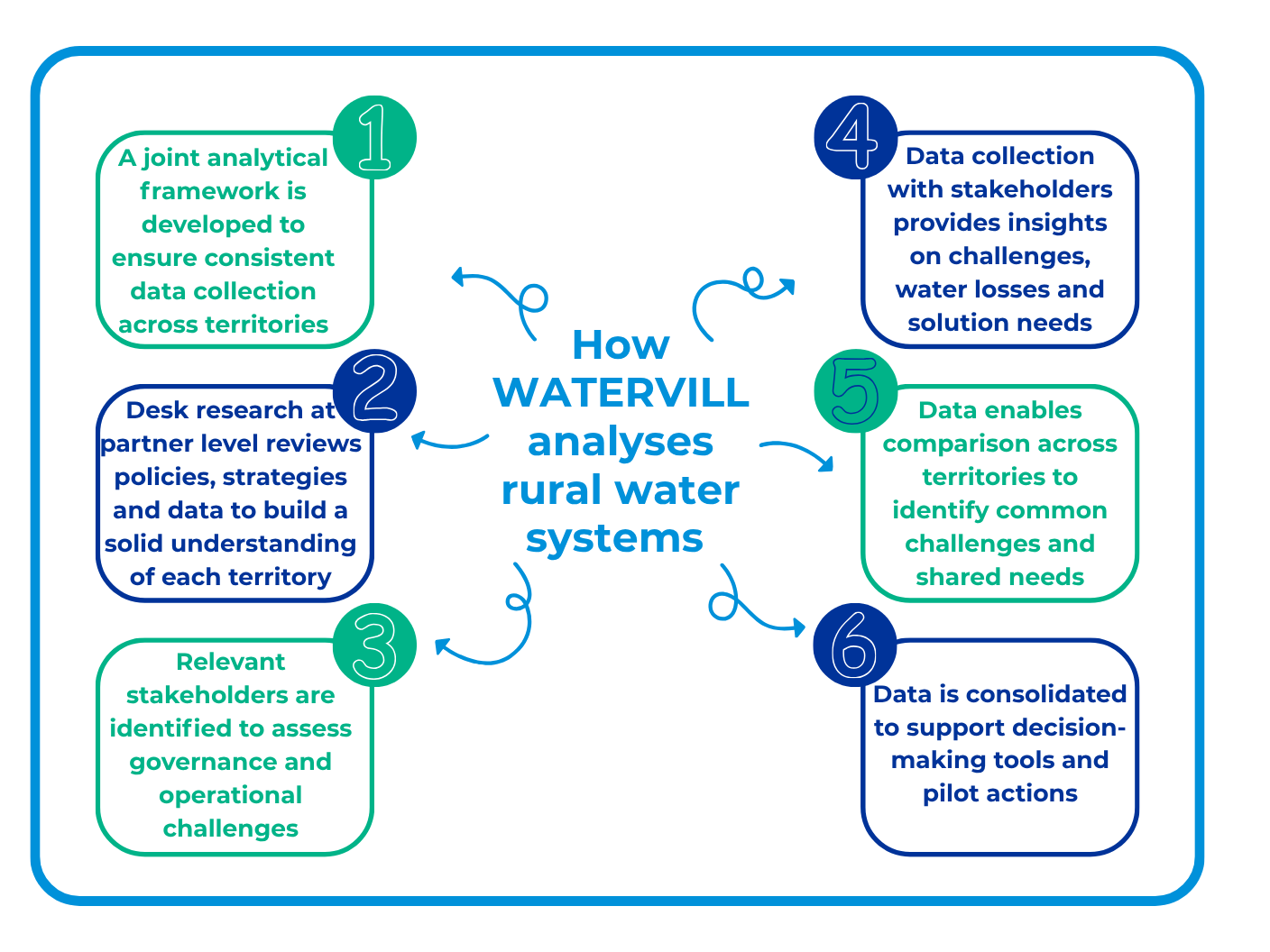
This work is carried out by university partners (UNIZAG, UOWM, UPV) and SOS, led by the University of Zagreb, through a combination of qualitative and quantitative approaches, structured into several key steps, outlined below and illustrated in the accompanying schema:
Preparatory meeting
- Partners develop a joint analytical framework for data collection, ensuring methodological consistency across participating territories.
Examples of information collected include:
• Baseline information on rural and village water supply systems, including technical characteristics, how the systems currently operate, how they are managed and owned, and who they serve
• System data (number of users, network length, supply units)
• Time-based data (water supply flows, demand patterns, water losses)
• Spatial data (network mapping data, locations of infrastructure and users)
• Financial data (costs, revenues, expenses and water loss-related costs)
• Climate-related data (water scarcity, seasonal variability, climate risks)
• Governance information (management models, roles of stakeholders and institutions)
• Performance data (water quality, system reliability, maintenance practices)
• Key challenges and areas for improvement in sustainability, resilience and efficiency
2. Desk research is carried out at partner level to collect and review relevant policy documents, strategies, regulatory frameworks, studies and available datasets related to the case study areas. This step ensures a solid baseline and contextual understanding of each territory;
3. Relevant representatives are identified, including sectoral agencies, water utility professionals and local decision-makers, who play a key role in identifying governance and operational challenges within existing water supply systems;
4. Primary data collection is then conducted with these stakeholders. This enables partners to gather qualitative insights on operational challenges and governance gaps, as well as quantitative data such as non-revenue water levels and population served. It also captures stakeholder input on digital solution needs, community participation and climate resilience measures;
5. The collected data allows for a comparative analysis at transnational level, helping to identify common challenges, shared needs and context-specific differences across territories.
6. Finally, the data is consolidated into a comprehensive knowledge base, supporting further project activities, including the development of joint decision-support tools and pilot actions.
The schema below summarises the above-mentioned steps: